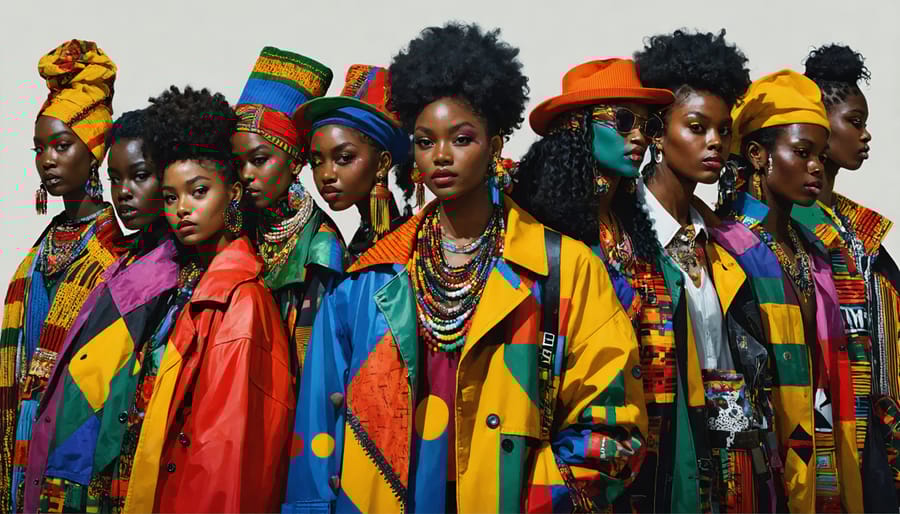
Fashion is understood as a periodic system for introducing
changes in individuals' lifestyles. Although it has been an
active mechanism
throughout the different eras that humanity has experienced, in this century it has intensified due to the various
media. Through these, it establishes very short cycles—which can last
barely a few months—and manages to affect all
aspects of life.
Fashion, driven by advertising and information, constitutes
the ecosystem in which the active lives of the citizens of
the consumer population develop. It is simultaneously another system of
social distinction and stratification.
Fashion is related to the idiosyncrasies of each country.
As a symbol and subtle expression of human reality, it encompasses everything from
economics, technology, and science to psychology,
the sociology of history. Expanding on these topics, one can
observe that
fashion presents two factors that fulfill the
demands of consumer society and seems expressly designed
for it. Fashion fuels the desire to distinguish oneself and stand out from the crowd; constituting the ideal mechanism to accelerate the commercialization of production.The faster the succession of fashions and the more distinct they are, the better.
Changes generate movements that impact, first and foremost, the most sensitive members of society: the creators. They are the first to absorb and process the new reality and respond with creations.
Fashion, then, arises from the creator, who, drawing on their ingenuity and external stimuli, regroups elements familiar to all with their signature style.
According to the author Wood, "The language of clothing is modified, mutates, and adjusts its content and forms at a much more dizzying pace and across a much broader scope.
The first and most immediate space we inhabit is clothing, which is also the factor that most conditions the body in terms of posture, gestures, communication, and the interpretation of sensations and movement. In this link the body and its environment, marking the boundary between public and private. Clothing covers, reveals, and modifies the body according to a specific body type; it suggests, accentuates, or conceals its forms. Is adapting to different circumstances and conditions, creating a new skin, where made it is the raw material from which the body's surface is modified, framing the anatomy and delineating a silhouette through different shapes. This , the textile participates in its morphology and generates a new relationship between the body and its environment; it is the element that materializes the design. (Wood, 2004).
Clothing, therefore, becomes a vital necessity that
has evolved throughout history, just like other
human behaviors.
The history of lingerie dates back to ancient
civilizations, where a practical way was sought to
cover the private areas of both women and men.
The design of clothing is formed from the interaction
of three systems: the supporting body, that is, aspects of
its appearance such as hairstyle, cosmetics, tattoos,
ornamentation, etc.; the clothing system, which includes
the elements worn and carried, such as clothes, footwear, and
accessories; and the context of reference, which encompasses
space, time, place, historical, cultural, and economic situation,
etc. (Wood, 2004).
Furthermore, fashion is used as a means of integration and
beautification. Indeed, attire is an element of
integration into society. Not surprisingly, when classifying, for example, what are called urban tribes, one of the elements that is considered is how they dress.When a young person wants to
integrate into one of these groups, even before accepting its
ideas, they imitate the clothing of that group.
Textiles serve many functions, ranging from clothing the
body to protecting humans from the environment.
In all of today's society, there is a certain tendency toward
uniformity; it's not exclusive to urban tribes.
It's about being like everyone else to fit in, and not standing out from the chosen social group with overly extravagant outfits. For this reason, so-called fashion trends are usually followed by most people.This project will consist of creating a lingerie and corsetry brand that adapts to the fashion and needs of new urban generational groups. It will target men and women between 15 and 25 years old, differentiated from their peers in their ways of thinking, interests, philosophy, lifestyle, and therefore, their way of dressing. For this reason, different sets of lingerie, corsetry, and underwear will be created according to the needs of each group. On one hand, there will be the general objective, for which a product line will be created
designed to satisfy the demand of teenagers and young adults, men and women between 15 and 25 years old, who want to show off their underwear and, through it, express their style or the social group to which they belong.
Gladys Acevedo states: "Corsetry defines all garments
worn under street clothes. Lingerie refers only
to bed linens or sleepwear."